Thursday, May 18, 2006

The Evolving Market

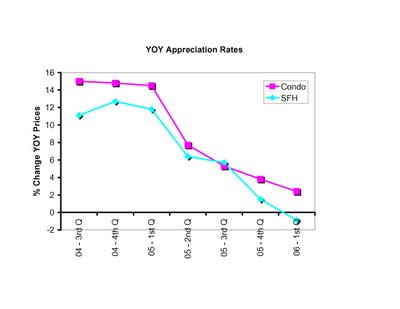
Each quarter the Massachusetts Association of Realtors issues a press release to accompany the sales and price numbers for the quarter. These press releases are archived on their website (here), and provide a telling recapitulation of the market's recent evolution. Each quarterly report (until the latest) ends with a quote from an MAR official summarizing market conditions (and in some cases offering up rosy projections). Recent quotes are reproduced below, accompanied by a link to each press release, and the YOY change in SFH prices for the quarter.

3rd Quarter, 2004 (11/15/04) SFH prices up 11.1%

“With today’s attractive mortgage rates, low down payment requirements, and steadily rising home values, it’s an ideal time to get into the housing market,” added Moore, who also noted that first-time buyers, immigrants, and baby-boomers who’ve reached their peak-earning years are all helping to keep demand for housing strong.

4th Quarter, 2004 (link) SFH prices up 12.7%

“Today’s healthy price increases are consistent with a market in which demand has outpaced supply, and we think that trend will continue in the coming year as large numbers of immigrant buyers and baby-boomers in their peak earning years hit the market,” said Tomkiewicz. “The good news for buyers is that we should see some moderation in price appreciation in 2005, especially if mortgage rates rise as forecasted,” she added.

1st Quarter, 2005 (5/12/05) SFH prices up 11.8%

“The current low interest rate environment is likely to prevent prices from falling any time soon,” Tomkiewicz predicted. Housing prices generally reflect supply and demand levels, so as long as mortgage rates stay attractive home buying activity should remain strong, thus prices should continue to climb rather than soften, she explained.

2nd Quarter, 2005 (8/15/05) SFH prices up 6.4%

“Predictions of a price bubble are simply unfounded, and ignore the fact that housing production across the state has failed to keep pace with demand,” asserted Tomkiewicz. “On top of that, zoning restrictions in many towns are contributing to today’s higher prices because they add to the cost of land and require that the homes that are built be larger in size. For these reasons, we don’t anticipate any decline in prices in the foreseeable future, unless the economy slips into a recession.”

3rd Quarter, 2005 (11/15/05) SFH prices up 5.7%

“With more sellers than buyers, especially at the upper end of the market, and mortgage rates now starting to rise, there’s not as much upward pressure on prices,” Tomkiewicz said. While sellers have started to adjust their asking prices, declines in property values are unlikely, according to MAR’s president, primarily because the risk of the market becoming overbuilt is minimal due to tough local zoning laws that restrict new housing production. “We expect homes will continue to appreciate in value in the year ahead, but more modestly than in recent times,” Tomkiewicz remarked.

4th Quarter, 2005 (2/15/06) SFH prices up 1.5%

“Prices may soften, but look for flat to modest appreciation this year rather than sharp price declines,” said Wluka.

1st Quarter, 2006 (5/15/06) SFH prices down 0.9%

No quote.

Wednesday, May 17, 2006

Nightmare Scenario?

Interesting article at MarketWatch today (Housing slowdown behind rise in inflation). The whole thing is worth a read, but here's the idea: housing is factored into inflation through rents, not house prices.

During the housing boom (while house prices surged) weakness in rental prices made CPI inflation (as measured) low, allowing the Fed to justify low lending rates.

Now this virtuous cycle is reversed: declining affordability means rental demand and prices are picking up, contributing to inflation pressures and further Fed action, which could further decrease affordability. The net effect in this nightmare scenario: increasing rents, increasing borrowing costs, falling home sales, and declining house prices (with increased borrowing costs offsetting an unknown portion of the decrease in purchase price).


Monday, May 15, 2006

The Bear Market Begins

The Massachusetts Association of Realtors (MAR) released cumulative market numbers for the 1st quarter of 2006 today, accompanied by a press release (here). Overall, 1st quarter sales of single family homes were off 6.5% relative to the 1st quarter of last year, while condo sales were basically flat relative to last year. SFH prices dropped 0.9%, while condo prices were up 2.4% relative to 1st quarter 2005. I have some doubts about the condo prices they report, given that their own monthly reports for Jan, Feb, and Mar report YOY price increases for condos of 1.9, 2.2, and 2.2%. No way this could result in prices for the quarter being up 2.4%. Nevertheless, the downward trends in price appreciation that began in the second quarter of last year remains intact.

In one year we've decelerated from double digit price appreciation to flat or negative price appreciation. Those with the most interest in keeping the market afloat continue to paint lipstick on this pig (see the MAR press release, and the latest Boston Magazine - BUY, BUY, BUY), uttering all the reassuring phrases about normalization, healthier levels of inventory, soft-landings, buyer's market, etc.

But their reassurances seem to be failing. How do we know? A stunning article in the Boston Herald last week revealed that Coldwell-Banker is, brace yourself, pressuring SELLERS to LOWER PRICES!!! This admission, more than any other, signals the end of the bull market and the true beginning of the housing bear market in Massachusetts. Market participants are out of excuses (weather, hurricanes, wait for the spring market, etc.), and it's clear to almost everyone that the sellers vastly outnumber the buyers. Want to sell your house? Price below the competition, and be prepared to negotiate. First time buyer? Wait if you can. If not, take your time, find exactly what you want, and offer below asking (after all, prices will likely be lower in a year).

Don't believe me? Ask Fortune, who labelled the Boston housing market a "Dead Zone" that is 30% overvalued. They lay out a worst case scenario:

For the past few years the housing boom has driven the economy, adding jobs in construction, remodeling, and real estate services. And consumers gorged on the equity in their homes, taking out a total of $2 trillion via loans, refinancings, and sales over the past five years.
Those powerful stimulants, which added a full point to annual GDP growth, will soon vanish. If corporate spending or some other force doesn't come along to pick up the slack, we could go into a recession that would cut income growth to zero. Then inflated housing prices would have to shoulder the entire, wrenching adjustment, falling 30 percent or more over several years.

Why worry about a seemingly unlikely worst-case scenario? Take a look at the homebuilders, on the front lines of the housing market nationwide. Their confidence in the future of the market is falling like a rock, and has reached an 11-year low (link here), while their stock market values have been tanking (52-week lows today for PHM, CTX, HOV, RYL, DHI).

Given the hand-wringing at Coldwell-Banker, I'm guessing the April numbers (to be released next week by MAR) are not pretty, and the spring market will prove insufficient to reverse current trends. At that point reality will be harder to sugar-coat, pressure on 'must-sell' sellers will continue to ratchet up, and price declines should accelerate.

Tuesday, April 25, 2006

March Market Wrap

Results for March were posted today by the Massachusetts Association of Realtors (link). Before going to the results, let me remind you that the March numbers represent sales typically originated in the preceding two months, in this case January and February. Given the mild winter of 2006 (especially January) and the brutal winter of 2005 (blizzard), I was expecting a nice bump in the numbers. Sales were up, but barely (about 2% yoy),, and prices were down for SFHs and up only slightly for condos.

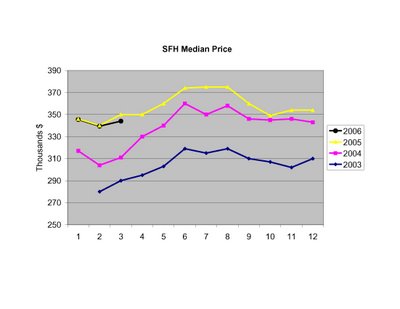
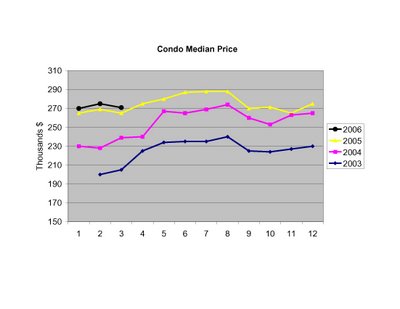
Here are the median sales price data for March:


SFH prices were down 1.7% relative to last year. Cumulative 1st quarter prices are also down. These results clearly demonstrate falling SFH prices on a statewide level.

Condo median prices were up 2.2% relative to last year, and will be up about the same for the 1st quarter. (Up in nominal terms, but down in real terms) Last year in the 1st quarter condo prices were appreciating at ~14%, so the market deceleration is clear.

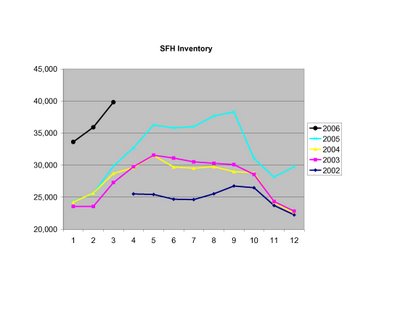
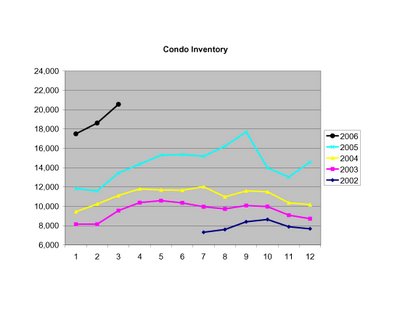
Inventory numbers continue to surge. According to MAR, inventory levels are the highest in more than a decade - and they show no sign of slowing.

Notice I had to extend the y-axis range in both plots to accomodate the growing inventory of unsold homes.

Similar MA sales and price numbers were also released today by the Warren Group, as reported in the Boston Globe (here).

Monday, April 17, 2006

Metrics of market direction

The Wall Street Journal's Real Estate Journal recently addressed the metrics to evaluate when sizing up a market's near-term direction. Let's see how MA stacks up:

As a rule of thumb, assume that most home shoppers won't want to take on a mortgage that's more than three times their annual income.
Creative financing and record-low mortgage rates made this rule of thumb temporarily obsolete, but rising rates will bring it back into play. While I don't know the average mortgage to income ratios in MA, the current ratio of median SFH price (2005) to median (2004) income is ~6.5, for condos it is ~5 in MA.

Among the local factors you should check are inventory levels, which measure how long it takes for houses to sell, assuming no other houses were listed. (Equilibrium is between five and six months -- anything shorter indicates tight supply, which tends to lead to higher prices).
No need to add to recent posts covering the surge of inventory levels that continues unabated.

Also check out housing starts and permits -- rising numbers could mean that a market is becoming overbuilt, which can cause prices to drop.
This is not typically a problem in MA, but I've made the case (here and here) that even the relatively modest increases in new construction currently underway will glut the market as outmigration and demographic changes play out (see here).

Also, take a look at time on the market -- if this number is rising, it can be an early warning sign that a market is cooling.
Check out this recent Boston Herald article that points out the growing inventory and days on market in MA.

Of course, you'll want to find out if prices are being cut in your target neighborhood.
Statewide median prices have already peaked and look poised to turn down as the year progresses. According to ZIP Realty, of the 46,500 houses for sale in the greater Boston area, >33% (15,700 houses) have reduced list prices. For a closer look at individual homes, towns, and zip codes, including historical value plots, check out the wealth of info available at Zillow.com.