Saturday, January 28, 2006

Prices for New Homes Deflating?

Numbers out yesterday on sales of new homes. While the headlines focused on the surprise increase in sales (a volatile number with great statistical uncertainty), less attention was paid to the prices paid for new homes.

December 2004 Median Price: 229.6K
December 2005 Median Price: 221.8K
Percent Change: -3.3%

December 2004 Average Price: 284.3K
December 2005 Average Price: 272.9K
Percent Change: -4.0%

Those are YOY declines! Granted the decrease in prices reflects in part the sales weakness in the West (which has highest prices), but this is a stunning development, and one conveniently ignored by most interested parties.

A graphical summation of the trend from Calculated Risk:


Wednesday, January 25, 2006

Sixth Busiest December Ever!!!

MAR has the December market numbers (pdf) out for the Bay State.

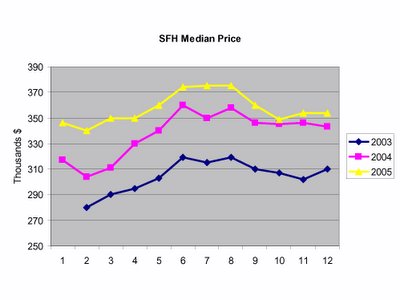
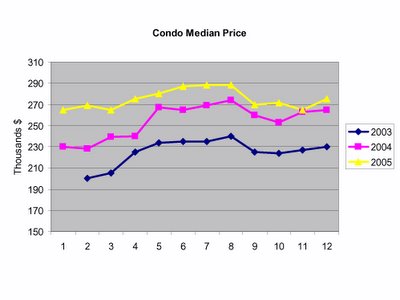
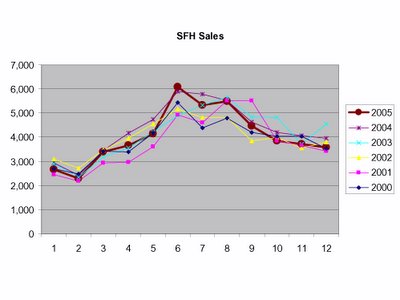
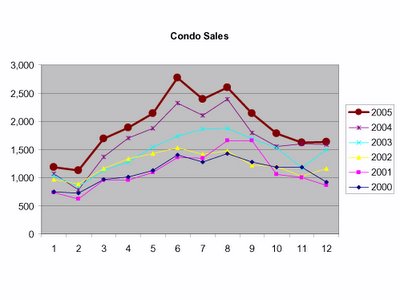
December 2005 sales volume ranks as the sixth busiest December on record for single-family home sales in Massachusetts, an indication that the market is merely returning to a more normal sales pace after experiencing an accelerated pace for much of past three years.

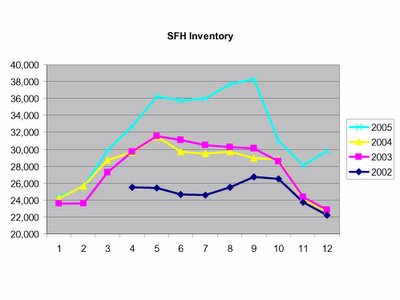
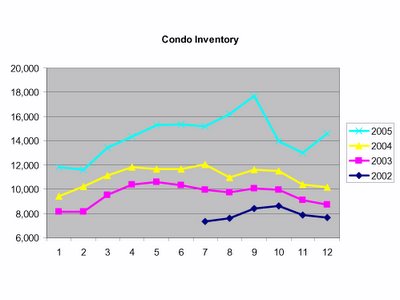
Prices are up marginally year over year, and condo sales continue to run stronger than SFH sales, at least relative to historical trends. The real news is a return to ballooning inventory (the telling data are plotted last).

Interestingly, the MAR seems perturbed about the bubble chatter:

False assertions of a price bubble in the local market also have prompted some buyers to delay their home buying decisions .

Their reassurance for those in doubt:

Despite concerns about an inventory glut, there’s a healthy balance between supply and demand at the present time.

Truth or fiction? They state that equilibrium in MA occurs at 7.5-8.5 months of housing inventory. OK, but in one year inventory has surged from 5.8 to 8.3 months for SFHs, and from 6.4 to 9 months for condos. Think inventory is going to magically stabilize now that we've reached a 'balanced' state?

Here are the numbers:

In my opinion, here's the real news - check out the shocking surges in December inventories.

Tuesday, January 24, 2006

Greenspan's Legacy

Excellent article by Nell Henderson at the Washington Post about Alan Greenspan and the US economy.

My favorite bits:

Under Greenspan's watch, the economy thrived despite stock market crashes, international financial crises, terrorist attacks, wars and other shocks. No wonder, as Greenspan prepares to retire next week, economists have lauded him as the greatest central banker ever.

Still, his legacy will be judged not just by his record at the Fed, but also by the economy he bequeaths. And when he leaves office Jan. 31, Greenspan leaves a nation awash in debt -- record household debt and a record trade gap.

...low interest rates worked like an intoxicant on consumers, who snapped up new cars and trucks with no-interest loans and seized on low mortgage rates to buy new homes and refinance old home loans. Household spending rose in 2001, 2002, and 2004, even as the wealth and income of the typical household fell or remained flat in the same period, according to an analysis by Moody's Economy.com... household debt rose faster in recent years than wealth or disposable income, reaching an unprecedented 126.1 percent of after-tax income in the third quarter, double its 1980 level.

When questioned on Capitol Hill in June about criticism that the Fed's strategy had helped inflate a housing bubble, Greenspan suggested that such imbalances were an acceptable price for avoiding another depression or a Japan-like economic stagnation. "We knew that in the process of what we were doing -- that is, addressing the consequence of a very severe deflation of a [stock] bubble -- carried with it potential side effects," Greenspan said. "As best we can judge, things have turned out reasonably as we had expected, both positively and negatively, but in our judgment, the positive effects of the policy far exceeded the negative ones."

So there you have it straight from the Maestro's mouth - the housing bubble is an acceptable price, and a predictable and necessary side effect of rescuing the economy from the last bubble.

Which leaves one to ask, what (or who) will rescue us from the curent bubble (or is it still just froth)?

Ghosts from another time...
As we near the time of Greenspan's exit, let me quote from John Kenneth Galbraith in "The Great Crash":

A bubble can be easily punctured. But to incise it with a needle so that is subsides gradually is a task of no small delicacy. Among those who sensed what was happening in early 1929, there was some hope but no confidence that the boom could be made to subside. The real choice was between an immediate and deliberately engineered collapse and a more serious disaster later on. Someone would certainly be blamed for the ultimate collapse when it came. There was no question whatever as to who would be blamed should the boom be deliberately deflated. The eventual disaster also had the inestimable advantage of allowing a few more days, weeks, or months of life.

When reflecting on the current state of affairs, definitely wait for the sands of time to flow before passing ultimate judgement on the success of our current Fed.

Don't Panic

When the National Association of Realtors says "Don't Panic, " what do you think?

In November, housing inventory – the number of homes available for sale – rose to its highest level since April 1986. Once again, the Chicken Littles came out of the henhouse shouting the “sky is falling”. They suggest that, with mortgage rates rising and demand slowing, a rise in inventory will inevitably cause home prices to crash.

Hmmm, a wee bit overly sensitive about the term crash?

Well, for those waiting for the crash, you can leave your protective headgear behind. Home prices are not going to crash. It’s simply not in the cards.

Why not? Check out the link. It's the same old stuff - money is still cheap, demand is still high, the economy is sound. All are true, but notice that all of these things are backward looking, and the current trends are all in the wrong direction. Best of all is this reason there won't be a crash:

Homeownership has proven itself as a viable investment alternative to stocks and bonds. Since 2000, there have been $4 trillion dollars in home equity gains. That is equivalent to $70,000 per household, an exceptional return on investment. For most homeowners, their home has an additional benefit – it provides shelter for them and their families.

There you have it - the NAR has so embraced the speculative mania of the housing market, they now view the fact that a house can provide shelter as a nice secondary benefit.

Still, shouldn't we be worried about all that inventory?

At the national level, we can see that home sales are slowing, the month-supply is rising, and as a result, balance is returning to the market. As a result, we do expect home prices to soften in the coming months. And slowing sales are good for the long-term health of the housing sector. So we should welcome a moderate slowdown, not panic from it.

But later on...

So, even though inventory may rise, home prices are not necessarily headed for a downturn. It is true that price appreciation may slow due to a softening of demand because of higher interest rates. But there will still be buyers out there. The good news is that there will be an available supply of homes for them to purchase.

So which is it? I guess with a press release like this, you can't get it all wrong.

Now for the local angle:
What markets had the biggest surge in inventories from the 3rd quarter 2004 to 3rd quarter 2005?

Chicago/Naperville/Joliet....132%
Binghamton, NY...............125%
Boston/Cambridge/Quincy......115%
Washington, DC................98%
Baltimore/Towson..............95%

Saturday, January 21, 2006

Affordability - Stretched to the Max?

The issue of "affordability" is complex. It combines elements of income, cash available as down payment, mortgage interest rates, creative mortgage practices, and ofcourse price.

The simplest argument in support of rising prices: incomes are rising in tandem to support the prices. One look at the image below refutes this notion in MA.
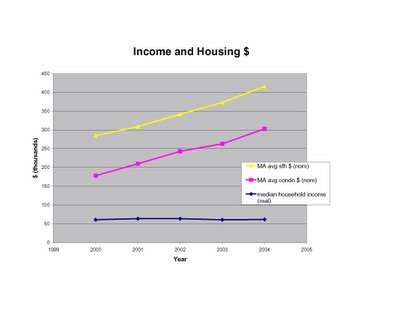
Real household incomes (adjusted for inflation) have been stagnant in MA for the past five years. The average home price has increased 46% and the average condo 70% over the same timespan. Yes, I've compared inflation adjusted income to non-inflation adjusted house prices, but one could easily argue that since house prices aren't included in inflation measures (rents are), then real income is the proper comparison.

So how to account for people's ability to afford these prices? The cost of borrowing money reached multi-generational lows in the last 4 years. Here are the 30 yr fixed, and 1 yr ARM rates on January 1 of the past 7 years.
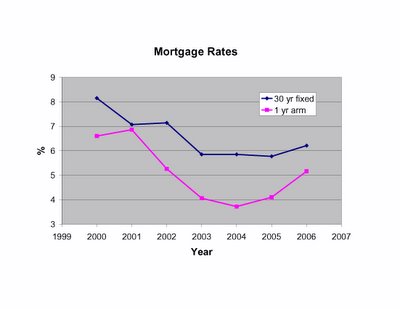
No question, low rates increased the purchasing power of those stagnant incomes. Couple this with the well-marketed message that only "monthly costs" are important, and suddenly people could afford to pay higher prices for an asset using "affordable" monthly payments.

Here's where things get worrisome. The escalating prices, and the psychology of "real estate never goes down," and "get in now or you'll be left behind" led inevitably to panic buying, bidding wars, and speculation.

Nothing epitomizes speculation better than interest-only mortgages. (I know they can be a cash-flow tool for the financially savvy, but come on, how many IO loans are being used that way?) Take a look at the explosive growth in IO mortgages in MA as people have been stretching to purchase inflating assets.
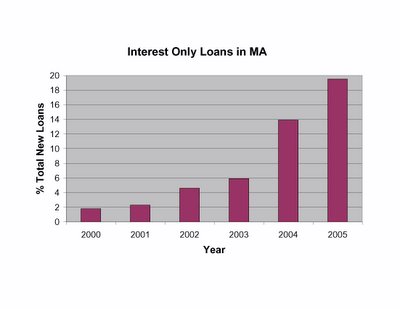
Keep in mind, with these loans no principal is payed for a defined period. The principal is then payed down on an accelerated basis after the interest only period - leading to payment shock. The only equity accrued during the IO period is through price appreciation - and the only way to refinance these mortgages without spending a big pile of new $ is to have some equity. If you want to see some amazing home-financing horror stories, and get a sense of the crazy lending practices that got us to this point, check this blog out.

Even if you can refinance, the rise in short-term interest rates almost guarantees some amount of payment shock. What happens if you can't afford the new payments? Sell, or face foreclosure. If you don't have any equity, selling is a $ losing proposition. MA foreclosures rates have already begun to climb.

And I haven't even talked about the enormous value of adjustable rate mortgages in the US that will begin resetting in 2006 ($300 billion) and 2007 (a staggering $1 trillion), and are already creating problems for MA borrowers.

So have people really been able to afford the homes they have purchased over the past few years? Perhaps more importantly, will they continue to be able to afford their payments? The answer to these questions will likely have far-reaching consequences for the local, and even global economy.